
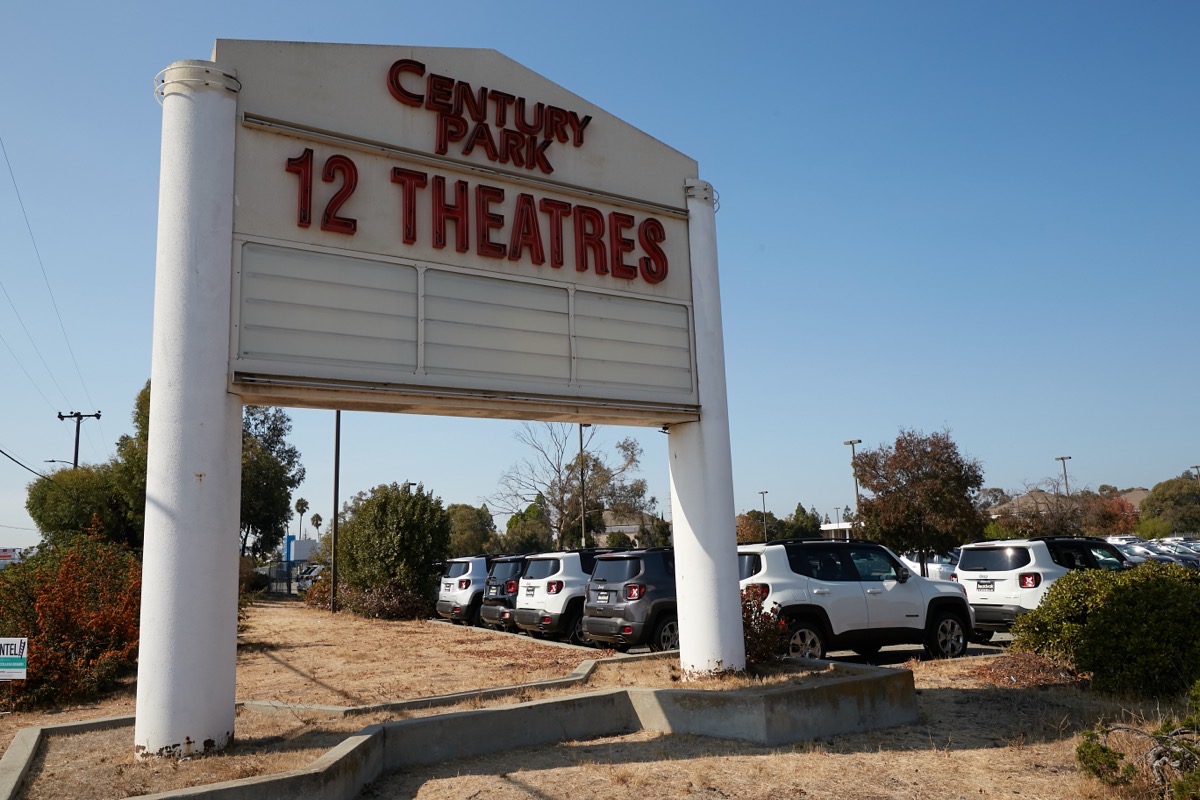
The auditorium ceiling is a roof deck with nothing holding up its middle
What makes a cinema roof different from a retail box is what is not there: interior columns. A single auditorium spans 80 to 150 feet of clear deck so sightlines stay clean from screen to back row, and a multiplex stacks eight, twelve, or sixteen of those bays side by side. That geometry changes how the roof moves and how it has to be fastened, and it is why we never carry a strip-mall detail onto a theater. We start every cinema project by confirming the deck and span we are actually working over.
St. Petersburg's screens sit in a few recognizable places — the multiplexes near Tyrone Square and the 66th Street North retail district, the entertainment anchors out in the Gateway and Carillon area off I-275, and the smaller independent and historic houses downtown around Central Avenue and the BayWalk/Sundial blocks. The big-box multiplexes are typically wide-span steel deck over structural steel; the downtown houses are older concrete and masonry. Each substrate gets a different attachment strategy.
Acoustics and clear-span decks go together
A theater roof is also an acoustic boundary. Patrons inside expect a quiet room, and the building sits under thunderstorms, aircraft on approach, and its own roaring rooftop units. The deck assembly and the insulation are part of how that noise is managed, so we are careful not to undercut it during a reroof — we keep the assembly mass and continuity the building was designed around, and we avoid attachment methods that would telegraph rooftop-unit vibration into the auditorium below. On the wide steel-deck bays we verify rib depth and gauge and run pull-out testing, because the short ribs on older deck hold far less than modern three-inch deck, and a fastening pattern that is wrong for the span shows up as both a leak risk and a noise complaint.
A penetration cluster that rivals a hospital
Mechanical density on a cinema is striking. Each auditorium carries its own rooftop unit, and around them sits concession exhaust, kitchen and popcorn-vent stacks, walk-in cooler condensers for the food and beverage operation, and the conduit runs feeding projection and sound. The cluster above a busy multiplex looks more like a hospital roof than a retail one. We inventory every curb, duct, and pipe, flash each one to detail, and document it on a roof plan before any membrane covers it. On a low-slope theater roof in our rainfall, a single neglected curb is all it takes.
Older downtown houses are their own problem
The independent and historic single-screen and small-house theaters near Central Avenue are not just smaller multiplexes — they are older buildings, often masonry with concrete or wood-plank decks, tall street-facing parapets, and decades of patch-on-patch roofing. The high parapets that give these houses their facade also trap water and complicate drainage and edge metal, and the deck underneath frequently hides moisture and prior repairs that only a core sample reveals. On these we core to confirm what is actually in place and how much weight the roof is carrying before deciding between a recover and a full tear-off, and we detail the parapet and through-wall scuppers carefully because that is where an old downtown theater roof usually gives up first.
Drainage, the show schedule, and the marquee
Theater roofs are big, flat, and decades old, and they almost always carry ponding from settled insulation. We design tapered polyiso to move water to the drains and finish with a reflective 60- or 80-mil TPO that meets the cool-roof requirement on local reroof permits, with reinforced walkway pads along the service routes to the units. The work itself runs against an evening-and-weekend show calendar, so we sequence tear-off and dry-in so every section is watertight before the first showtime and coordinate any rooftop-unit shutdown for off-hours. The marquee and entry-canopy connections — chronic leak points where supports pierce the membrane and the canopy meets the wall — are re-flashed as their own line items, not buried in the field scope.
Frequently asked questions
What system do you put on a multiplex?
Tapered polyiso to fix the drainage, topped with reflective 60- or 80-mil TPO that satisfies the cool-roof energy requirement on local permits. We add reinforced walkway pads on the paths crews use to reach the rooftop units, since service traffic is what wears a theater membrane out near the equipment.
How do you fasten the big clear-span auditorium decks?
We confirm the deck type, rib depth, and gauge and run pull-out testing before committing to a pattern, because older short-rib steel deck holds far less than modern deck. Where deflection across the span is a concern we move to an adhered or hybrid assembly to avoid concentrating point loads at the seams.
Will the roof work disturb the acoustics or the screenings?
We protect the assembly that controls auditorium noise rather than thinning it, and we avoid attachment that would carry rooftop-unit vibration into the room. The work is scheduled against the show calendar — disruptive tasks in off-hours, every section dried in before showtime, and any HVAC shutdown coordinated in advance.
How is a cinema reroof priced?
Per roof square, after a roof walk and core samples, based on the membrane spec, the existing assembly condition, the penetration density, and rooftop access. Most multiplex jobs include a tapered insulation design; it adds cost but pays back by ending the ponding that shortens a flat theater roof's life.
Do you fix the marquee and entry canopy leaks too?
Yes. Marquee supports and the canopy-to-wall transition are treated as individual flashing items. Those entry connections see thermal movement and settlement and are the most common chronic leak on an older theater — replacing the field membrane alone never resolves them, so we detail them separately on every project.
Recover or full tear-off — how do you decide on a theater?
The core sample decides it. If the existing insulation is dry, the deck is sound, and the building can carry one more roof within code and structural limits, a recover keeps the screens running with less disruption and less cost. If the cores come back wet, or there is already saturated insulation or a second membrane in place, we tear off to the deck — covering trapped moisture only buys a short reprieve before the deck corrodes and the leaks return over a full auditorium. We make that call on evidence from the building, not a preferred default.
 Hotel and Hospitality Roofing
 Multi-Tenant Retail Strip Roofing
 Warehouse Roofing
 Medical Office Building Roofing
 Commercial Roof Repair in St. Petersburg | Planned & Emergency
 Commercial Re-Roofing