
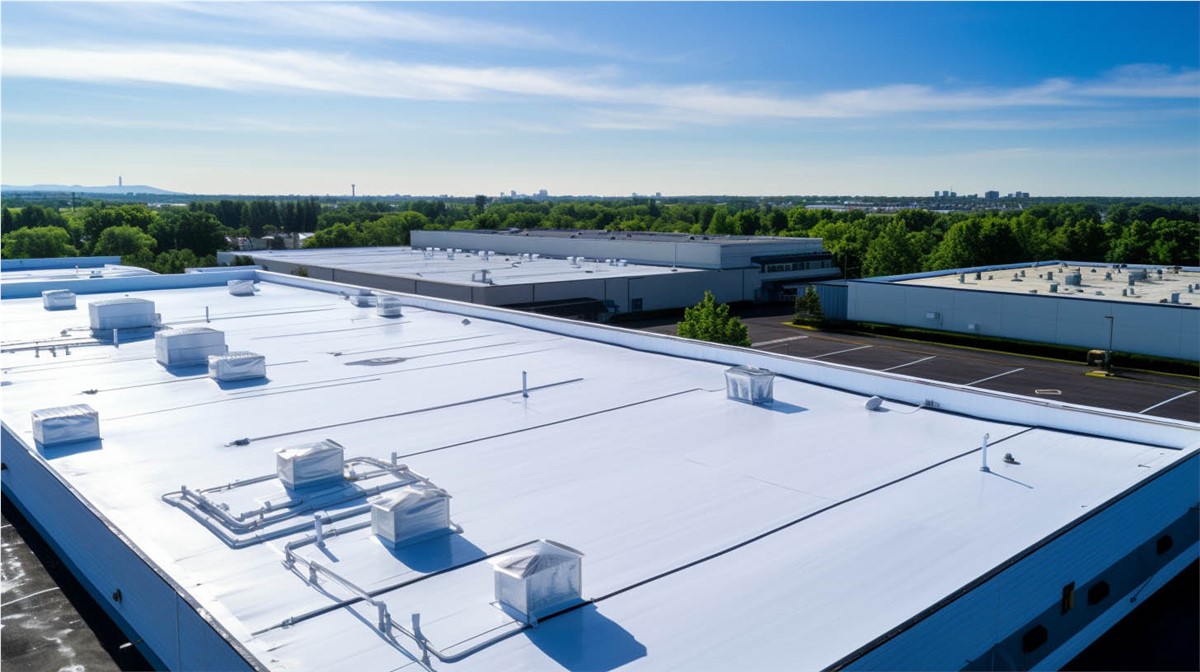
When afternoon thunderstorms roll across Tampa Bay from June through September, St. Petersburg commercial roofs face conditions that test every membrane on the market. A flat warehouse near Ulmerton Road or a multi-tenant retail strip along 4th Street North can sit under an inch of standing water within minutes of a major convective storm. Silicone roof coatings were engineered for exactly this scenario — they do not degrade or blister from prolonged ponding the way acrylic coatings do, making them the dominant choice for Pinellas County flat-roof commercial properties.
St. Petersburg averages 53.62 inches of annual rainfall, with June delivering 8.86 inches and July pushing nearly 9.73 inches — most of it falling in intense afternoon bursts rather than steady overnight rain. A roof drain that partially clogs between service visits can hold two to three inches of standing water on a low-slope TPO or modified bitumen surface for hours after a storm passes. Silicone's fully cured, 100% silicone chemistry resists that ponding indefinitely. Acrylic coatings, which are water-based, reabsorb moisture in those same conditions and soften, losing adhesion at the seams and flashings where protection is most critical.
Florida's subtropical sun compounds the challenge. St. Petersburg records roughly 361 days of measurable sunshine annually, and UV radiation at this latitude degrades acrylic binders faster than in northern markets. Silicone coatings contain no organic binders that UV can attack — the silicon-oxygen backbone is inherently UV-stable, which is why a quality silicone application on a Carillon Business Park office building typically delivers 10 to 15 years of performance before recoating is warranted. The energy argument is equally compelling: a white or light-gray silicone coating reflects 80 to 90 percent of solar radiation, reducing rooftop surface temperatures that otherwise exceed 180°F on a midsummer St. Pete afternoon. That cooling load reduction translates directly to lower electricity bills on Duke Energy Florida or TECO rate schedules.
Acrylic coatings are not obsolete in Pinellas County — they remain appropriate for sloped commercial metal roofs, such as R-panel buildings in the Gateway area or metal roofing on industrial facilities near St. Pete-Clearwater International Airport, where water evacuates quickly and ponding is not a risk. Acrylic's superior color retention and paintability make it a sound choice for visible sloped surfaces where aesthetics matter. But for the vast majority of St. Pete commercial flat roofing, silicone is the right tool.
The application process matters as much as product selection. Silicone must be applied to a clean, dry, and structurally sound substrate — a point that becomes critical after a Pinellas County wet season. Before any coating project, our crews core-cut the existing membrane to assess insulation moisture content and infrared-scan low points where water retention is likely. Wet insulation found during that survey must be removed and replaced before coating begins; coating over saturated insulation locks moisture into the assembly and guarantees premature failure regardless of what product goes on top.
Coating thickness is another variable where field discipline separates durable installations from warranty calls. Most silicone systems require a minimum 20-mil wet-film thickness — applied in two passes — to achieve a monolithic waterproof film over every seam, lap, and penetration. On complex downtown St. Pete rooftops with dense HVAC curbs, pipe stacks, and parapet conditions, experienced applicators take longer to detail those transitions properly. Rushing that work to hit a day-rate target is the most common cause of early coating failures we remediate on existing systems installed by less experienced contractors.
Barrier island hospitality properties — hotels and vacation rental buildings along St. Pete Beach, Treasure Island, and Madeira Beach — face an added layer of salt-air exposure that accelerates corrosion on any metal components the coating must transition to. We specify coating systems compatible with coated aluminum edge metal and integrate a detail membrane over all coping-to-roof transitions before the flood coat goes on, preventing the salt-driven corrosion channel that otherwise develops between metal and substrate.
Pre-hurricane season inspections and coating touch-ups have become a standard item in the maintenance calendars of well-managed Pinellas County commercial portfolios. A silicone-coated roof in good condition — with all penetration details intact — is a meaningful asset when Category 1 or Category 2 wind and rain arrives. Coatings that are chalking, delaminating at laps, or cracked around HVAC curbs provide no meaningful hurricane-rain resistance. We recommend a spring walk-through each April or early May to identify and repair any areas before June 1 marks the official start of Atlantic hurricane season.
Owners managing multiple properties across the Ulmerton Road corridor, Gateway industrial parks, or the Central Avenue commercial strip often find that a phased silicone coating program — addressing the buildings with the highest moisture risk or the oldest existing membranes first — provides the best return on a fixed annual capital budget. We can sequence a multi-building assessment and prioritize based on core-cut results, infrared findings, and remaining membrane life rather than guessing from the ground.
Questions Owners Ask
Is silicone coating appropriate for a roof that already has an acrylic coating on it?
It depends on adhesion. Silicone adheres poorly to many acrylic surfaces. We test adhesion by scoring the existing coating and performing pull tests before specifying a silicone overcoat. If adhesion is marginal, a primer formulated for that substrate or a full acrylic removal may be required. Applying silicone over a failing acrylic base in St. Pete's heat will produce delamination within the first wet season.
How long does a silicone coating last on a St. Petersburg flat commercial roof?
A properly applied, 20-mil or thicker silicone system on a sound substrate typically delivers 10 to 15 years of waterproofing performance in Pinellas County conditions. UV exposure, ponding frequency, and foot traffic intensity all affect longevity. Annual inspections to clear drains and touch up any penetration details are the single most effective way to reach the top of that range.
Can silicone coating be applied over existing TPO or modified bitumen?
Yes — silicone adheres well to clean TPO and APP modified bitumen surfaces when properly primed. The existing membrane must be structurally sound, free of active delamination, and have an insulation moisture content below 25 percent verified by core cuts. We do not coat over saturated or structurally compromised membranes regardless of the substrate type.
Will a cool roof coating actually reduce my energy bills in St. Petersburg?
Yes, and more significantly than in most US markets. St. Petersburg's annual cooling load is one of the highest in the country — the city averages a 73.9°F annual mean and essentially no heating season. A high-reflectivity silicone coating can reduce air-conditioning electricity consumption in an unconditioned or poorly insulated commercial building by 15 to 25 percent, depending on existing R-values and HVAC efficiency. The payback on coating cost through energy savings is typically three to six years at current Duke Energy Florida and TECO rates.
What happens if a hurricane hits after we have a new coating installed?
A properly installed silicone coating on a mechanically sound substrate does not peel off in hurricane winds — the coating film is not a structural element and is not subject to wind uplift the way a loose-laid membrane might be. The more relevant hurricane concern is whether the underlying membrane and insulation attachment meet current Florida Building Code wind-uplift requirements. We evaluate uplift compliance during our pre-coating assessment and flag any deficiencies before proceeding with coating work.
 Commercial Roof Repair in St. Petersburg | Planned & Emergency
 Commercial Re-Roofing
 Occupied Building Re-Roofing
 Roof Recover and Overlay