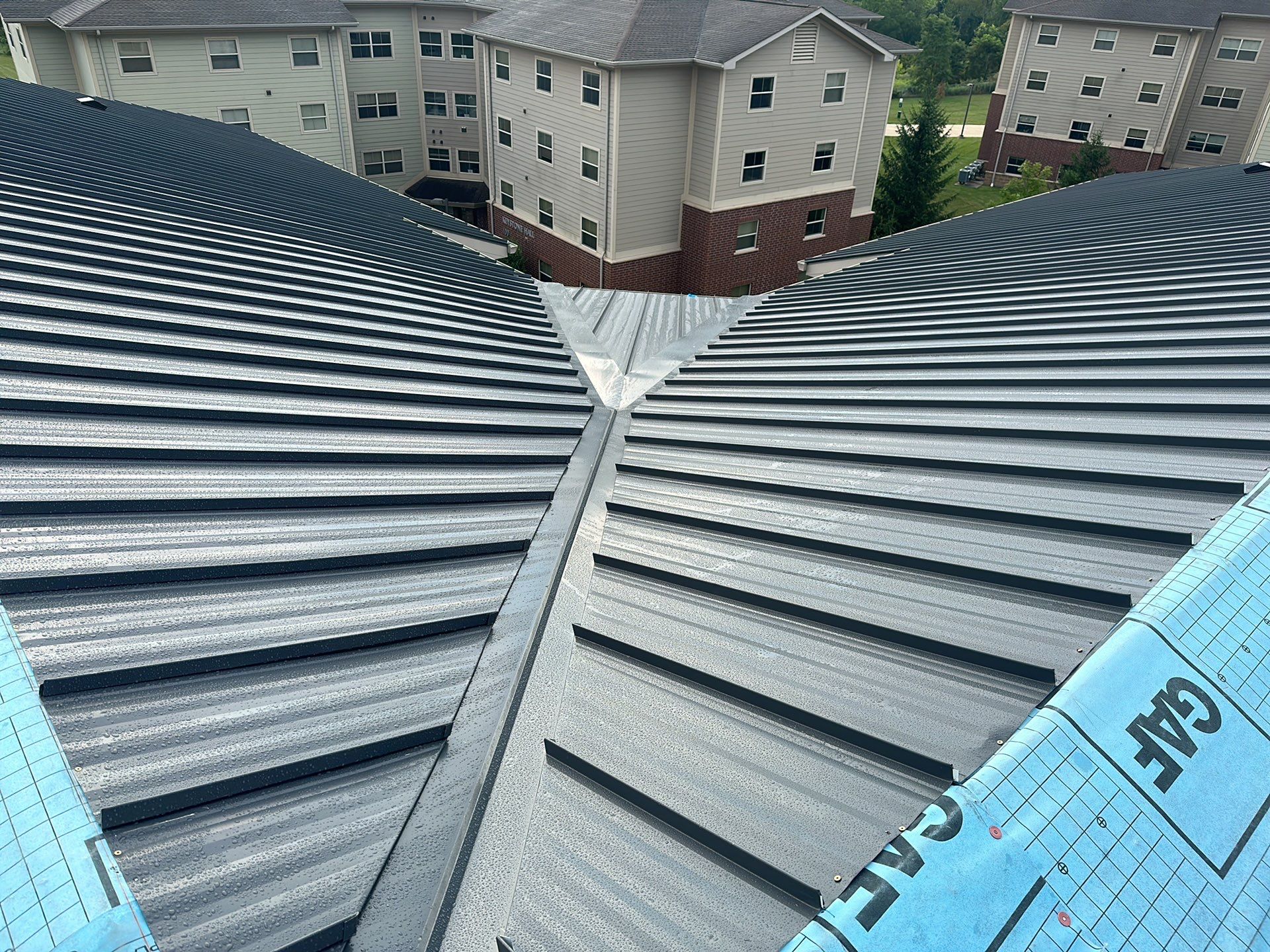
Standing Seam Metal Roofing occupies the premium tier of the St. Petersburg commercial roofing market — specified for properties where longevity, aesthetics, hurricane wind resistance, and the long-term economics of a 40-to-50-year service life justify the higher upfront installation cost. Carillon Business Park's professional office campus, waterfront commercial buildings along Tampa Bay and the Boca Ciega Bay corridor, barrier island hospitality properties on St. Pete Beach and Tierra Verde, and institutional buildings throughout Pinellas County increasingly specify standing seam as the architectural standard for new commercial and renovation projects where the building's identity and long-term asset value are the primary cost-justification framework.
The concealed-fastener design that defines standing seam is a fundamental performance advantage in St. Petersburg's salt-air and hurricane environment. Unlike R-panel and other exposed-fastener metal systems where screws penetrate the panel face at every attachment point, standing seam uses concealed clips that lock into the raised panel seams and attach to the structure below without penetrating the panel weathering surface. This eliminates the fastener-at-panel-surface corrosion and leak initiation point that is the primary maintenance liability of exposed-fastener metal in Pinellas County's coastal atmosphere. On a barrier island property within direct salt-water spray range, the corrosion protection advantage of a concealed-fastener system over a 20-to-25-year horizon is substantial — the exposed-fastener system requires systematic fastener replacement programs and eventually panel replacement that a standing seam system avoids entirely.
Hurricane wind certification is where standing seam metal's engineering advantage over lighter roofing assemblies is most clearly demonstrated. Florida Building Code wind-load requirements for Pinellas County commercial buildings are among the highest in the continental United States, and standing seam metal panels with proper engineering can achieve FM Global 1-90 or FM 1-105 wind-uplift classifications (90 to 105 psf) that substantially exceed what most single-ply membrane systems achieve. For barrier island buildings in the higher wind-speed exposure categories, and for buildings that have sustained hurricane damage under previous systems, meeting a higher wind-uplift standard is not simply a code compliance exercise — it is a direct reduction in the probability of roof failure during a Category 2 or Category 3 event that tracks across the Tampa Bay region.
The material selection between coated steel and aluminum for standing seam applications in Pinellas County is driven by salt-air exposure proximity. Aluminum is the dominant choice for barrier island properties and waterfront buildings within a half-mile of salt water — aluminum does not rust, and its natural oxide layer provides inherent corrosion resistance in salt-air environments where carbon-steel-based panels would require meticulous coating maintenance to avoid surface rust. PVDF (Kynar 500) painted coated steel panels are appropriate for most inland Pinellas County locations and provide excellent color retention and corrosion resistance at a lower material cost than aluminum. The boundary between aluminum-appropriate and coated-steel-appropriate in the St. Pete market is approximately three to five miles from direct salt-water exposure, with barrier island and immediate waterfront properties clearly in the aluminum zone.
Thermal movement is a performance engineering consideration for standing seam systems in Florida's climate that is often underweighted in conversations that focus on hurricane resistance. A 100-foot standing seam panel spans an annual temperature range from approximately 60°F to 180°F — a 120-degree thermal swing between a cold January morning and a July afternoon peak. That temperature differential generates approximately 1.5 inches of panel length change over a 100-foot panel run. Standing seam clip systems are specifically designed to allow this thermal movement without creating stress at fastener points or panel seam connections — the floating-clip mechanism that accommodates thermal expansion is what makes standing seam's concealed-fastener design work. Field-fabricated standing seam or panels installed without proper floating clips will develop buckled panels, seam separations, or fastener-point failures within a few years of service in Florida's thermal cycling environment.
Tampa Bay waterfront commercial buildings — restaurants, marine services, and mixed-use properties along Shore Drive, the EDGE District waterfront, and the properties visible from the new St. Pete Pier development — face an aesthetic standard that matches their functional requirements for salt-air durability. Standing seam metal's architectural appearance is appropriate for these high-visibility commercial locations in a way that built-up roofing or standard TPO is not. The combination of design-forward visual character and functional durability in a salt-air hurricane environment makes standing seam the specification standard for premium waterfront commercial projects in this segment of the market.
Standing seam installation requires field skill and equipment that not all metal roofing contractors in Pinellas County possess. Continuous roll-forming of panels on-site — the method used for longer spans where transportation of pre-formed panels would be impractical — requires a specialized roll-former machine, experienced operators, and field quality management that confirms seam profile consistency throughout the installation. Seam crimping — the process of locking the standing seam profile — requires properly calibrated electric seamers that create consistent engagement pressure throughout the seam length. Under- or over-crimped seams create either loose profiles that allow wind infiltration or over-stressed profiles that crack during thermal movement. Contractor qualification verification — including reference projects and equipment capability assessment — is warranted for any standing seam specification on Pinellas County commercial buildings where the installation quality determines hurricane performance.
The economic case for standing seam over TPO on long-life commercial buildings is straightforward on a life-cycle basis. A quality standing seam installation with proper maintenance has a 40-to-50-year service life in Florida conditions — two to three times the typical 20-to-25-year TPO service life in this climate. When that longevity advantage is modeled against comparable annual maintenance costs (standing seam has lower annual maintenance frequency requirements than TPO given its lack of weld seams to inspect and its superior corrosion resistance at the clip attachment), the total cost of ownership over a 40-year horizon often favors standing seam despite its higher initial installed cost, particularly for high-exposure coastal Pinellas County locations where the replacement cycle for a TPO system may be shorter than the theoretical 20-year maximum.
Questions Owners Ask
What wind speed can Standing Seam Metal Roofing withstand in Pinellas County?
Properly engineered standing seam systems achieve FM Global 1-90 to 1-105 classifications (90 to 105 psf uplift resistance) with appropriate panel gauge, clip spacing, and fastener patterns. The design wind speed for Pinellas County under ASCE 7-22 / FBC 2023 for a standard commercial Risk Category II building is approximately 130 to 140 mph, which translates to design uplift pressures of 50 to 70+ psf at perimeter and corner zones. Quality standing seam systems meeting FM 1-90 or 1-105 classification provide adequate uplift resistance for these design requirements, with substantial margin above the nominal design wind speed for most exposure categories.
Is aluminum or steel standing seam better for a waterfront St. Pete building?
Aluminum is the correct specification for any building within approximately half a mile of direct salt-water exposure — barrier island properties, waterfront buildings along Tampa Bay and the Gulf of Mexico, and marina-adjacent commercial properties. Aluminum's inherent corrosion resistance in salt-air environments eliminates the surface rust risk that coated carbon steel carries when coating is breached or at cut edges. For inland Pinellas County locations with limited direct salt-water exposure, PVDF-coated Galvalume steel provides excellent corrosion resistance at lower material cost than aluminum.
Can standing seam metal be installed over an existing flat commercial roof?
Yes — standing seam can be installed over an existing flat roof using a subframing system that creates the necessary slope and provides clip attachment points. This recover approach is common for commercial buildings transitioning from flat membrane roofing to sloped metal, and it eliminates tear-off cost while improving the roof drainage and longevity profile. The subframing design must account for the added dead load on the existing structural deck, and an engineer of record review may be required for larger projects. This approach is particularly common on strip commercial buildings along Ulmerton Road and Gateway area corridors where flat-to-sloped conversion improves the building's drainage performance and visual appearance simultaneously.
What maintenance does Standing Seam Metal Roofing require in the St. Pete climate?
Annual inspection is recommended — specifically examining seam profile integrity (checking for any crimping failures or seam separation), clip exposure at eave and ridge conditions, and condition of any sealant or tape in endlap, penetration, or ridge cap conditions. Gutter cleaning before wet season is important for standing seam buildings with integral gutter systems. Salt-air buildings benefit from periodic panel washing to remove salt deposits that concentrate at low points and accelerate coating degradation at the micro level. Metal-to-metal contact points — pipe stacks, curb transitions, flashing conditions — should be inspected for galvanic corrosion where dissimilar metals may be in contact.
My standing seam roof is making cracking or popping sounds during temperature changes. Is this normal?
Thermal expansion and contraction of metal roofing panels naturally produces low cracking or ticking sounds as panels move within their clip channels during morning warm-up and evening cooling cycles. This is normal behavior and does not indicate a structural or waterproofing problem in a properly installed system. Louder popping or banging sounds, particularly if concentrated at specific panel locations, may indicate that panels are binding in their clips rather than moving freely — a condition that can develop if clips were improperly installed or if debris has accumulated in clip channels. Binding in clip channels can eventually produce seam profile distortion or clip fatigue failures. An inspection of the areas where abnormal sounds originate is warranted if the sound pattern is new or has changed in character.
 Commercial Roof Repair in St. Petersburg | Planned & Emergency
 Commercial Re-Roofing
 Occupied Building Re-Roofing
 Roof Recover and Overlay