
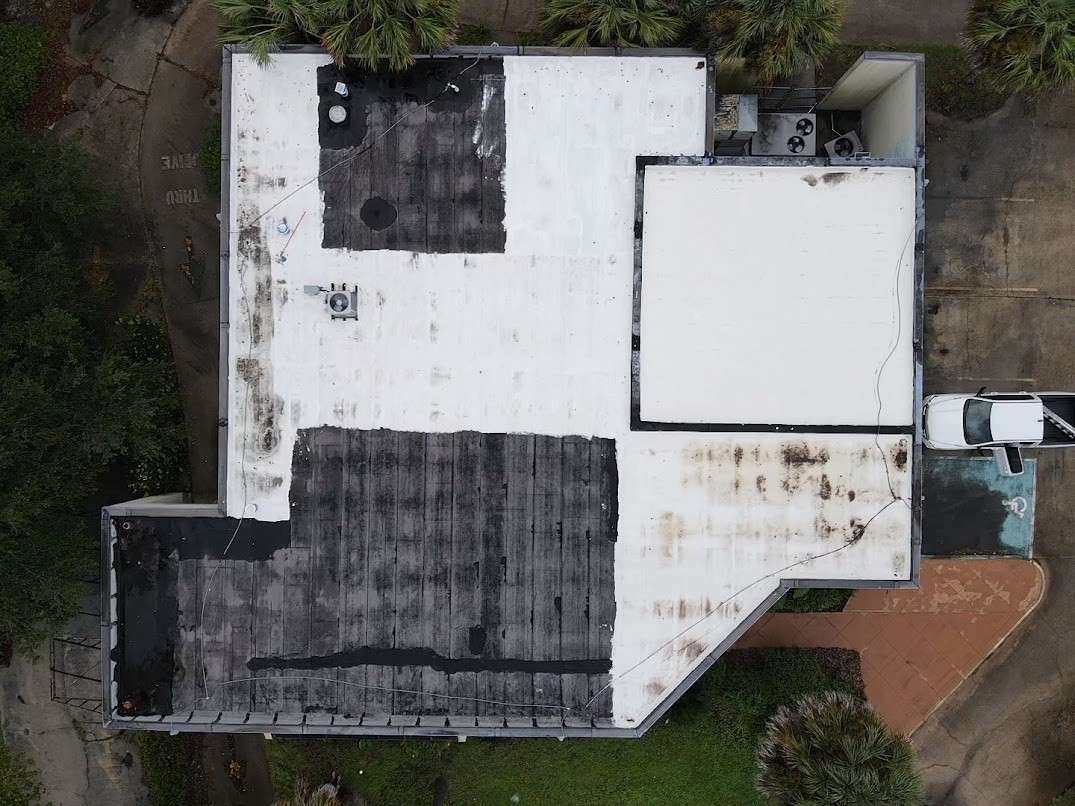
St. Petersburg's commercial corridors include the Downtown and Edge District redevelopment zones, the Gateway and I-275 commercial belt, the Midtown area, and the expanding Carillon Park and Gateway employment areas. Storm damage documentation and insurance claim roofing in this market requires a contractor who can produce GPS-tagged hail impact maps, wind damage assessments, and supplemental claim documentation in the format that commercial property adjusters use — not just a repair estimate, but the evidence package that documents the claim at full scope.
St. Petersburg does not have a storm season — it has a storm culture. The recognition that severe weather is a recurring operational reality rather than an exceptional event shapes how commercial property owners, facilities managers, and roofing contractors in this market approach their relationship with building maintenance. From the afternoon thunderstorm cells that develop over Tampa Bay and the Gulf of Mexico on nearly every summer day to the organized tropical systems that track through the Gulf of Mexico from June through November, the buildings in this city face a weather threat profile that is genuinely different from most US commercial markets. Storm Damage Roof Repair is not a specialty service in Pinellas County — it is a core commercial roofing competency.
June-September afternoon thunderstorm damage and hurricane-season tropical event damage are the two primary storm damage categories in St. Pete, but they produce different failure patterns that require different response approaches. Afternoon thunderstorm damage is typically localized: a specific seam that was already marginal allows water entry under the increased head pressure of an intense localized downpour; a drain that was 50 percent obstructed creates a ponding event that overwhelms an adjacent flashing detail; wind gusts from a severe cell partially lift an edge metal section that was corroding at its fastener connections. These are the subtle failure modes that would never manifest during a steady moderate rain but are reliably exposed by the intensity of a St. Pete wet-season event.
Hurricane and tropical system damage creates both the dramatic large-scale failures that are immediately visible — membrane panels peeled back from entire building sections, HVAC equipment displaced from curbs, edge metal stripped from parapet walls — and the subtle widespread damage that looks intact from the ground but has compromised waterproofing integrity in ways that subsequent rain events will demonstrate. The subtle damage category — membrane punctures from debris impact, micro-cracks in penetration flashings from pressure cycling, adhesion failure in seam areas that experienced repeated wind-load reversals — is the damage type that produces ongoing interior leaks for weeks after the storm itself, frustrating building owners who thought the obvious repairs had resolved all storm impacts.
The Central Avenue commercial corridor, the EDGE District, and the Warehouse Arts District are some of the most storm-vulnerable commercial segments in St. Pete due to the combination of older building stock, complex historic rooflines with dense penetrations, and urban canyon effects that can amplify wind loads during storm events. Older masonry commercial buildings along Central Avenue from downtown through the Grand Central District have building envelopes that were designed before the current era of extreme weather intensity — their parapets, window openings, and roof-to-wall transitions are details that require particular attention after any significant storm event, as these buildings develop storm-related building envelope failures at locations that would not be vulnerability points on more modern construction.
Barrier island commercial properties along St. Pete Beach, Treasure Island, and Madeira Beach are at the highest storm exposure level in Pinellas County for both wind and water damage. Gulf-facing buildings experience unobstructed onshore wind during tropical events, and the combination of wind-driven rain and occasional wave action against ground-floor commercial uses creates a building envelope stress profile that differs from anything encountered by inland commercial properties. Post-storm roof repairs on barrier island properties must account for the fact that water may have entered the building through multiple pathways simultaneously — not only through roof membrane failures but also through window and door seals, through-wall penetrations, and wall cladding joints. The roof repair scope on a severely storm-impacted barrier island hotel, for example, is rarely limited to the membrane and flashings visible from the roof surface.
Storm damage repair permitting in St. Petersburg follows Florida's post-storm emergency repair provisions, which provide expedited permit pathways for emergency work required to prevent further damage. However, expedited permits are not the same as unpermitted work — licensed contractors and documented scopes are still required, and permanent repairs that result from temporary emergency protective measures require standard permitted scopes. Building owners should ensure that post-storm repairs beyond temporary tarping are executed by licensed Florida roofing contractors who pull the appropriate permits rather than by unlicensed emergency responders who do not. Unpermitted permanent storm repairs can create complications at future insurance renewals, property sales, and resale inspections.
The timing of storm damage repair in Pinellas County's regulatory environment is affected by the permit queue conditions that follow major storm events. After a significant hurricane impact on Pinellas County, the local permitting department processes a surge of repair permit applications that extends review timelines. Temporary protective measures can be implemented immediately without permits, but the scheduling discipline of converting from temporary to permanent repair as promptly as the permit process allows is important — temporary tarps and emergency patches are not designed for multi-month Florida wet-season exposure, and delays in permanent repair allow ongoing weather events to expand original storm damage through continuing infiltration.
Documentation from storm damage events should begin immediately after the storm's passage, before any emergency repairs are made. GPS-tagged photographs of every damaged area visible from ground level, from the roof surface if safe to access, and from the interior below damaged areas establish the storm-caused damage pattern at its worst. This documentation record supports insurance claims, contractor scope development, and the building condition baseline for future comparisons. Every hour between storm passage and documentation is time during which building owners, tenants, or emergency first-responders may move or disturb debris that contributes to the damage record. The urgency of documentation is not bureaucratic — it is directly proportional to the complexity of the insurance claim that follows from storm events in this market.
Questions Owners Ask
What is the first thing I should do after a storm damages my commercial roof in St. Petersburg?
Document the damage with photographs before anything is moved or covered — this is the most important single action for insurance purposes. Then contact your insurance carrier to open a claim. If there is active water intrusion into occupied spaces or electrical/equipment areas, contact a licensed roofing contractor for emergency temporary dry-in while the formal insurance process proceeds. Do not wait for the insurance adjuster's visit before addressing active water intrusion — emergency protective measures are covered as part of the storm damage claim and are expected by carriers to prevent further damage.
Is all storm damage covered by my commercial property insurance in Pinellas County?
Most commercial property policies cover wind and water damage from named storms and general severe weather events as covered perils. Specific exclusions vary by policy — common exclusions include flood damage (separate flood insurance required through NFIP or private market), pre-existing maintenance deficiencies that contributed to storm damage severity, and cosmetic damage that does not affect building function. Review your specific policy declarations and exclusions with your broker. In the current Florida commercial property insurance market, policy terms have tightened significantly — understanding your specific coverage before a storm event rather than after is essential.
My building sustains small leaks every major summer storm. Is that a storm damage issue or a maintenance issue?
If the leaks occur repeatedly at the same locations following every significant storm, the root cause is almost certainly a pre-existing deficiency that storm intensity is consistently exposing — not a new storm damage occurrence each time. Recurring leak locations in St. Pete typically indicate a specific flashing detail that is performing marginally under normal rainfall but failing under storm intensity, or a drain that is partially obstructed and overloading adjacent membrane seams when rainfall exceeds drain capacity. Addressing these as recurring maintenance deficiencies — by finding and correcting the root cause — is more effective and less expensive than filing insurance claims for what is functionally a maintenance problem presented as storm damage.
How do I find a reputable contractor for Storm Damage Roof Repair in St. Pete after a major hurricane?
Verify active Florida roofing contractor license status at myfloridalicense.com before signing any agreement. Request proof of current general liability and workers' compensation insurance certificates. Ask for references from recent commercial storm damage repair work in Pinellas County — not general references, but storm-specific references. Legitimate contractors will not demand large upfront payments or pressure you to sign before your insurance adjuster has visited. Be specifically cautious of out-of-state vehicles with magnetic signs appearing in your area after a major storm — these are often unlicensed storm chasers without Florida credentials or accountability.
Can storm damage make a previously repairable roof unrepairable?
Yes. A storm event that drives significant water into a roof assembly through an existing or storm-created entry point can saturate insulation across a large area in a single event. When combined with existing deferred maintenance that had the assembly close to the recover-ineligible threshold, one major storm infiltration event can push the insulation moisture content past the point where recovery is viable. Similarly, a storm that causes widespread membrane wind-uplift failure on a building that already had two roof layers may trigger the full tear-off requirement that makes recover permanently unavailable. Post-storm assessment of these threshold conditions is part of every storm damage inspection we perform on St. Pete commercial buildings.
 Commercial Roof Repair in St. Petersburg | Planned & Emergency
 Commercial Re-Roofing
 Occupied Building Re-Roofing
 Roof Recover and Overlay